In American schools, a hidden epidemic unfolds every three minutes: Students are spotted smoking. Health professionals consider teens who vape as a complete epidemic. According to CDC there are more than 40% of highschool students and over 80% of middle schoolers who had tried electronic cigarettes. A majority (99 percent) of them have nicotine, a chemical that is addictive and changes the wiring of brains in developing children and frequently can be used as a means to smoking cigarettes. Teachers, parents, and administrators are under increasing pressure to act. The vape detector is an advanced tool that is rapidly becoming a must-have on campuses all over the world. Triton as well as 3D Sense are the two most sophisticated vape detectors schools can make use of. They do more than just create an alarm.
How do Vape Detectors Work: Precision Without intrusion
Modern vape smoke detectors like the Triton Ultra Smart Safety Sensor isn’t dependent on audio recordings or cameras, ensuring 100% privacy compliance while still providing actionable insights. It makes use of particulate sensors to analyze the air in real-time. The device will notify personnel via text message or email when vape aerosols, or masking agents, such as strong perfumes, are detected. False positives remain exceptionally low, which gives administrators the confidence that every notification demands immediate attention.
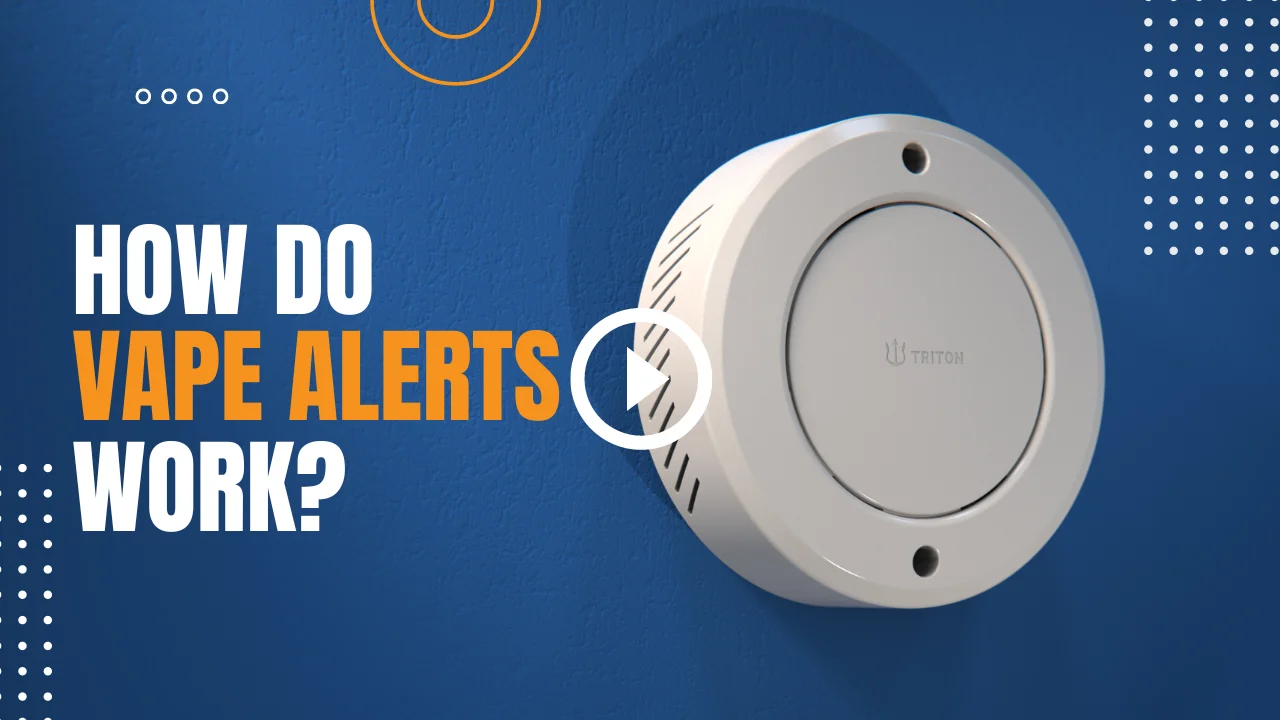
The expense of deployment is decreased when one unit is able to cover a room. Triton customers usually report the vaping rate dropping within five weeks. Why? Data-driven deterrence. Triton Cloud Dashboard offers an “hotspot” of where and when vaping is occurring the most frequently. Principals are able to send security guards or hall monitors to where they’re most needed.
Beyond Detection, Occupancy Visibility and Loitering control
What distinguishes Triton in a different way from standard vape detectors is its patent-pending occupancy display technology. The ULTRA sensor does not require images or even sounds to track the time of people’s stay and count in sensitive areas. Administrators are able to view heat maps colored by color that show when bathrooms become social hubs, which are the most popular locations to smoke and also the long-term close contact that can spread respiratory illnesses.
Stanford Medicine research emphasizes the stakes. Students who use vapes are 5 times more likely to contract COVID-19. By reducing congregating the vape community, these devices help improve air quality and lower the risk of transmission of the airborne pathogens. Following the pandemic, this benefit has elevated these devices from a mere option to essential.
Transforming data into discipline and Dialogue
The numbers can tell a story. The reports module in Triton’s software provides the quantitative proof of incidents’ timestamps and locations. It also reveals trends in frequency. Schools are able to present the information to schools’ boards of directors, parents’ groups and even students. It is when skepticism fades that an institution reports a 60 reduction in detections after detectors were placed in place. Parents can sense the dedication, and students understand the implications.
Teachers can increase the impact of their message by announcing the presence of vape smoke detectors since day one. For example the 3D Sense model is marketed as an anti-deterrent. “Let students know the air itself is watching,” guidance materials advise. The social cost of raising an alert can be more significant than a talk.
A Multi-Front Strategy Schools Can’t Ignore
Vape detectors are not the only instrument that can stop the use of vape. They are part of a comprehensive strategy.
Monitoring – Real time alerts capture incidents as they are happening.
Education – Research-based findings are the main source of anti-vaping education.
Deterrence – Visible signage and other known consequences alter behaviour.
Discipline – Hotspot data justifies targeted enforcement.
Support – Schools provide resources to help struggling students stop smoking.
The CDC emphasizes that changing the trend demands “buy-in from parents, educators, and society.” Vape detectors are an important missing element: immediate, objective feedback that turns positive intentions into tangible outcomes.
Deployment Conveniently
Triton Cloud Dashboard makes it easy to register your devices. Administrators can customize notification rules and add contacts. A single demonstration shows the ease of use that this interface offers. is. It allows users to schedule one-on-one time to see live hotspot maps and historic graphs in real time.
Conclusion
Every puff that is not taken seriously could lead to an addiction that lasts for a lifetime. Every bathroom occurrence which is not spotted is the risk of your health and safety. Vape detectors for schools like Triton and 3D Sense offer more than surveillance they deliver intelligence, deterrence, and proof of progress. Schools that install them don’t simply respond to the growing vaping epidemic but they also take control of the issue.
With one sensor per room, privacy-safe occupancy insight, and rapid-alert systems, these tools transform vague worries into tangible victories. Waiting is not an option in this day and age, where 40% of high school students have tried it, and the percentage of middle schoolers are increasing each day. The air you breathe in your school contains evidence. Make sure you’re the first to learn what it’s saying.